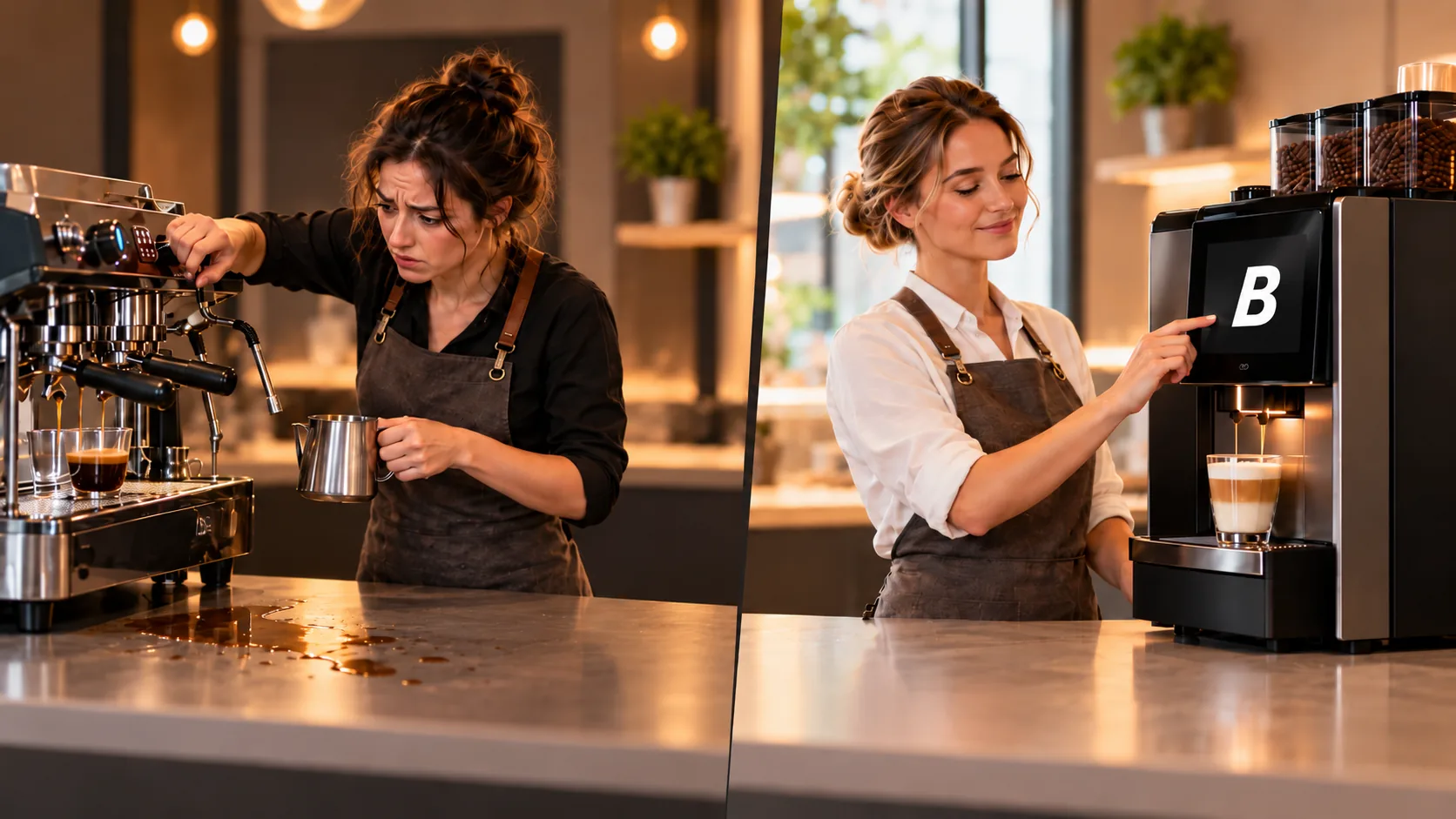
If you're weighing up a bean-to-cup vs espresso machine for your café, here's the short version. A traditional espresso machine gives a skilled barista the most control and the most theatre, but the coffee is only as good as whoever is behind the counter that shift. A bean-to-cup machine makes the same drink every time at the push of a button, so your quality no longer depends on staffing. That trade-off matters more to most cafés than any spec sheet.
We should be upfront that Blend 2 Vend only supplies bean-to-cup machines. That's exactly why this guide spells out where a traditional espresso machine is the better choice. If your café is one of those, you should know before you talk to anyone, including us.
How Each Machine Actually Works Behind the Counter
A traditional espresso machine is half of a two-part setup: the machine and a separate grinder. For every drink, someone grinds and doses the coffee, tamps it into the portafilter, locks it into a group head and pulls the shot. They then steam and texture the milk by hand with a steam wand. Every one of those steps affects the cup. Each morning someone also has to "dial in" the grinder, adjusting it as the beans, temperature and humidity change.
A bean-to-cup machine does all of that inside one unit. The grinder, brewing chamber and milk system are built in, and the drink is programmed: grind size, dose, water temperature and milk texture are set once and repeated every time. Whoever is on shift chooses a drink on the screen, and the machine grinds fresh beans and makes it, usually in around 40 seconds on our machines.
Both use freshly ground whole beans. The difference isn't freshness; it's who, or what, is making the decisions for each cup.
The Real Question: Does Your Coffee Depend on Who's on Shift?
Most comparisons frame this as "quality vs convenience". For a café, a more useful question is: what does your coffee taste like on the shift your best barista isn't working?
With an espresso machine, the answer depends on your team. A well-trained, experienced barista on a well-set-up machine can make an excellent cup. A new Saturday starter in their second week usually can't, and your customer has no way of knowing which one they got until they taste it. Hiring and keeping trained baristas is a constant job, and every new starter goes through a learning period that your customers taste.
With a bean-to-cup machine, the cup a regular gets at 7am on a Monday is the same as the one they get at 4pm on a Sunday, whoever presses the button. One Blend 2 Vend customer who moved over from a traditional setup put it this way in a verified Google review:
"We recently switched from a traditional barista setup to a Blend2Vend machine and it's honestly been one of the best operational decisions we've made for the business. The quality and consistency of the coffee is spot on every single time, no matter which staff member is using it."
— David Breakingbury, verified Google review
This is why bean-to-cup suits so many businesses where coffee matters but isn't the whole show: a deli, bakery, farm shop, garden centre café, pub or bar. In those places the person serving coffee is also plating food, taking payments and clearing tables, so there's no one dedicated to the coffee.
Speed at Peak: Daily Capacity vs the Morning Queue
This is where the honest comparison gets more nuanced, and where most guides gloss over the detail.
A bean-to-cup machine generally makes one drink at a time. Our entry-level machines handle up to 100 cups a day, and our high-volume machines are built for 300 or more. For most cafés, the daily total isn't the limit. The limit is the busiest 20 minutes. At around 40 seconds a drink, a queue of ten customers wanting milk drinks takes several minutes to clear, however quickly your staff work.
A multi-group espresso machine lets several drinks be made at once, provided you have the trained people to run it. Two experienced baristas on a two- or three-group machine can make drinks side by side in a way one bean-to-cup unit can't.
So the practical sizing question isn't "how many coffees do we sell a day?", it's "what does our worst queue look like?". For a café with a steady flow of trade, one bean-to-cup machine is usually comfortable. A café with a very sharp commuter rush may need a higher-output machine or a second unit, and we'll tell you that at consultation rather than sell you something that will hold up the queue.
Where an Espresso Machine Is Genuinely the Better Choice
We'd rather lose a sale than install the wrong machine. A traditional espresso machine is the better fit if:
- Your concept is specialty coffee. If customers come for single-origin espresso, changing guest roasts, careful dialling-in and the craft of it, that control is the product. A bean-to-cup machine is designed to take it away.
- Latte art and hand-textured milk are part of your brand. Automatic milk systems produce consistent, good-quality milk, but a skilled barista with a steam wand has finer control over texture and presentation.
- You have a settled, well-trained barista team and plan to keep it that way. If you've already solved the staffing problem, the main advantage of bean-to-cup shrinks.
- Making the coffee is part of the experience you sell. For some cafés, watching a barista at work is part of the appeal, and a push-button machine doesn't offer that.
If several of those describe you, a traditional setup is the right call, and we'd say so.
Running Costs, Maintenance and Training
Training. An espresso machine needs real barista training and practice before someone is consistent on it. A bean-to-cup machine needs minutes, not weeks. We do on-site training at installation, but for most staff it's simply choosing a drink on the screen and knowing the daily cleaning routine.
Daily upkeep. Espresso machines need backflushing, cleaning the group heads and steam wand, and resetting the grinder whenever conditions change. Bean-to-cup machines run automated cleaning cycles plus a short daily routine, mainly for the milk system.
Mechanical complexity. Here the espresso machine has an advantage: it's a simpler machine with fewer moving parts. A bean-to-cup machine has more inside it, so regular servicing matters more. That's why ours come with first-year servicing and warranty included, a 24-hour support line and next-day callout, not as optional extras.
Ingredients and waste. With programmed doses, every drink uses the same amount of coffee and milk, so there are no dumped shots while someone dials in the grinder and no jugs of over-steamed milk poured away. For a fuller picture of what a machine costs to run, see our guide to commercial coffee machine running costs. If you want to model what better coffee could earn your café, try our profit calculator.
Bean-to-Cup vs Espresso Machine: Side by Side
| Traditional espresso machine | Bean-to-cup machine | |
|---|---|---|
| Who controls each drink | The barista, step by step | The machine, programmed once |
| Consistency across staff | Depends on skill and training | The same, whoever presses the button |
| Training needed | Significant | Minimal |
| Drinks at once | Several, with enough trained staff | Generally one at a time |
| Latte art / milk craft | Full control | Consistent, but no hand finishing |
| Daily upkeep | Backflushing, grinder adjustment, wand cleaning | Automated cleaning cycles plus a short routine |
| Mechanical complexity | Simpler | More complex: servicing matters more |
| Best for | Specialty coffee, barista-led cafés | Cafés and food-led businesses that want consistency without depending on a barista |
Switching From an Espresso Machine to Bean-to-Cup
If you already run an espresso machine and you're thinking of switching, the usual triggers are a machine due for replacement, a barista leaving, or customers getting a different drink depending on who's on.
A few things make the switch go smoothly:
- Taste it first. We bring a machine to you for a free demo, so you and your regulars can judge the coffee before anything changes.
- Match your menu. Drinks are programmed to your menu and cup sizes, so a flat white comes out the way you want it.
- Decide whether to buy or lease. Most cafés want to own their machine, since it's core equipment they'll use every day for years. You can buy it outright, with buy now pay later available, or lease it to own with no upfront cost, so it's yours at the end of the term. Our lease vs buy guide covers the trade-offs, and you can see the beans we supply on our coffee menu.
- Time the installation around trading. Installation is booked for a time that suits you, so you're not closing on a busy day.
Opening a new café rather than replacing a machine? Our guide to choosing a coffee machine for a new café covers sizing before you have footfall data, and financing without a trading history. If you're comparing bean-to-cup with self-service vending instead, see coffee vending machine vs bean-to-cup.
Frequently Asked Questions
Will customers notice it's not a "proper" espresso machine?
A bean-to-cup machine grinds fresh whole beans and makes real espresso-based drinks, so the coffee itself is proper espresso. What customers won't see is a barista tamping and steaming by hand, and you won't get hand-poured latte art. For most cafés and food-led businesses, a consistent, good cup matters more to regulars than the process. For a specialty coffee shop it may not, which is why we recommend tasting it at a demo first.
Can a bean-to-cup machine keep up with a busy café?
Usually, yes, as long as it's sized for your busiest period, not just your daily total. It makes drinks one at a time, so a very sharp rush may call for a higher-output machine or a second unit. We size on your peak queue at consultation.
Is a bean-to-cup machine more expensive than an espresso machine?
The machines themselves tend to cost more because there's more inside them. But the full comparison should include the separate grinder an espresso machine needs, barista training, and wasted coffee and milk. If the upfront cost is the sticking point, lease to own spreads it into monthly payments with nothing to pay upfront, and the machine is yours at the end. The best way to compare is a purchase or lease quote for your own site and menu. Talk to the team and we'll put one together.
Can I still use my own coffee beans?
Talk to us about this at consultation. Our service includes regular restocking of premium beans, milk and consumables, so supply is handled for you.
Do you supply traditional espresso machines too?
No. We only supply premium bean-to-cup machines, which is why this guide is open about when an espresso machine is the better fit.
Ready to Get Started?
If consistent café-quality coffee, whoever is on shift, sounds like what your business needs, the best next step is to taste it.
Book a free demo → and we'll bring a machine to your café, or speak to a specialist about your menu and your busiest hour.