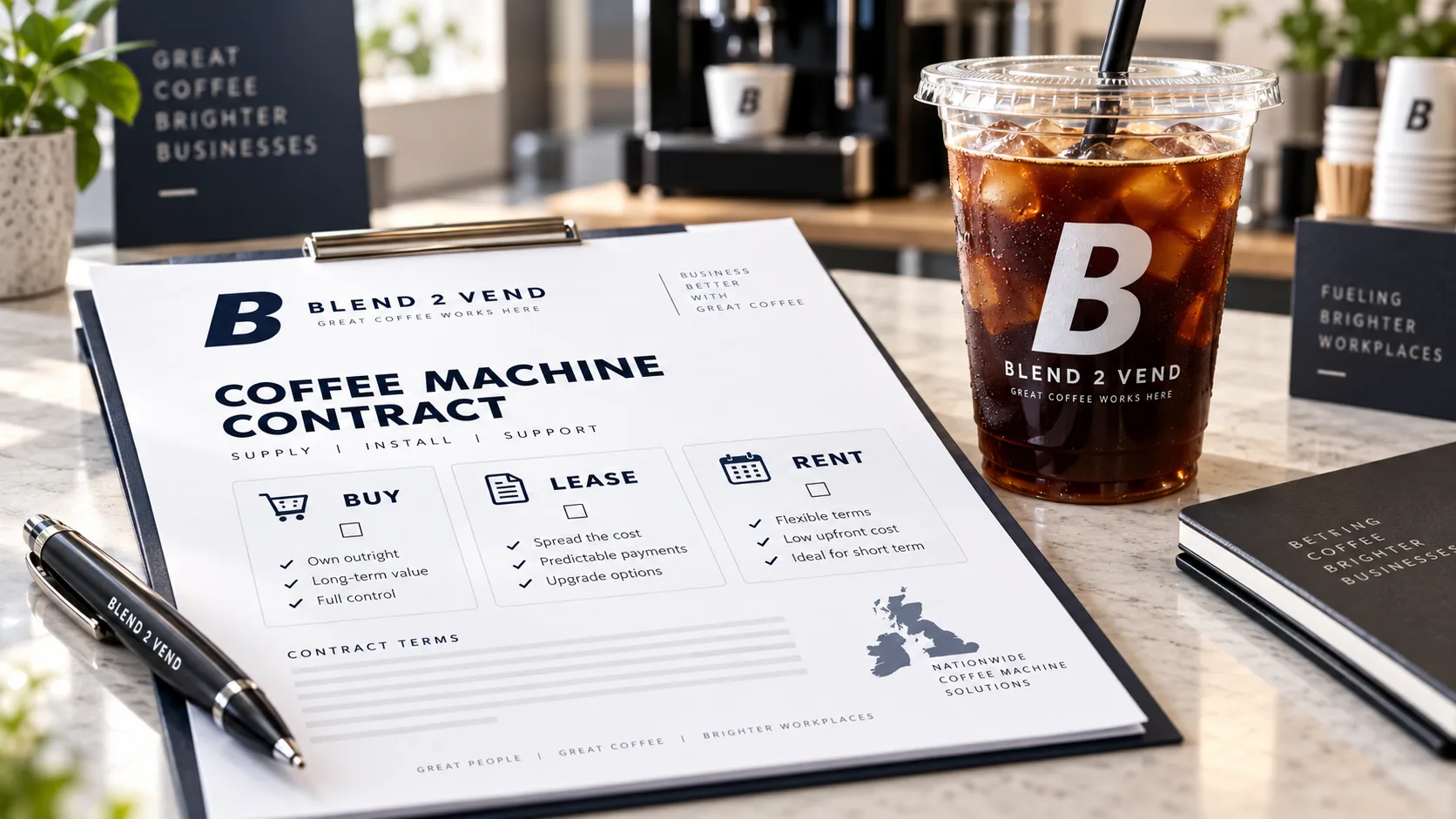
The coffee machine contract terms UK businesses most often get caught by are not hidden in the small print — they are simply never asked about. Six things decide what you actually pay over the life of an agreement: the minimum term, what is bundled into the monthly figure, whether you are tied to the supplier's consumables, how call-outs are charged, what happens at the end of the term, and what it costs to leave early.
This guide is written to be useful whoever you end up buying from. It is not legal advice, and for a high-value or multi-site agreement you should have someone review the paperwork properly.
Minimum Term and When the Clock Starts
The headline number most people check is the length of the term. The number they miss is when it begins.
Ask specifically:
- Does the term start at signature, at delivery, or at installation? These can be weeks apart, and it matters if you are trying to line the end date up with something else.
- Does a machine swap or upgrade restart the term? This is the one that catches people out most often. Accepting a bigger machine eighteen months in can quietly reset you to month zero on a fresh agreement.
- Does it auto-renew, and what notice stops it? An agreement that rolls into another twelve months unless you write in during a specific window is common and entirely legitimate — but only if you know the window exists.
Typical terms in this market run from twelve months to five years. Rental agreements tend to sit at the shorter end; lease-to-own agreements are usually longer because the payments are buying the machine. Our lease-to-own term is 36 months. We don't offer rental, because a rental term that ends with the machine going back rarely works out in the customer's favour.
What's Included in the Monthly Price and What Isn't
"Fully managed" is not a defined term. Two suppliers can both use it and mean quite different things.
Get an itemised answer on each of these:
- Installation and any plumbing work
- Staff training at handover
- Routine servicing, and how often it happens
- Parts, including whether wear items are treated differently
- Call-outs, and whether they are capped
- Beans and consumables — cups, lids, cleaning supplies
- Delivery of those consumables
Our monthly figure covers all of the above, which is why we quote one number. Plenty of suppliers price servicing separately from supply, and that is a perfectly normal model — but you need both figures to compare it against a bundled one.
The trap is comparing a bundled monthly price against an unbundled one and concluding the unbundled supplier is cheaper. Build the full annual cost for each before deciding.
Consumables: Are You Tied to the Supplier's Beans?
This deserves its own question because it can quietly become the largest variable cost in the agreement.
Some suppliers bundle consumables into the monthly price. Some sell them separately. Some require, or strongly recommend, that you use their own brand. As a published example, rijo42's lease page recommends "only using our rijo42 brand of coffee beans" — that is their stated position and there are legitimate technical reasons a supplier takes one.
Grind and roast profile genuinely affect how a bean-to-cup machine performs, and a supplier servicing the machine has a reasonable interest in what goes through it. So the point is not that tied consumables are wrong. The point is to establish three things in writing:
- Is it a recommendation or a contractual obligation?
- If it is an obligation, does using other beans affect the warranty or service cover?
- How is the price of those consumables set over the term, and can it rise?
That third question is the one people forget. A machine price fixed for three years alongside consumables that can be repriced annually is not a fixed-cost agreement.
We include beans, cups and lids in the monthly figure, supplied through a small-batch roaster in Brighton, so the question of repricing does not arise for our customers. Ask it of anyone you are comparing us against.
Servicing, Call-Outs and Response Times
Find out whether the response time you have been told about is contractual or aspirational. "Next-day callout" in a sales conversation and "next-day callout" written into the agreement are different things.
Then ask what is excluded. Most agreements distinguish between a fault and user error or neglect, and a call-out attributed to the latter may be chargeable. That is reasonable, but you want to know the rate and who makes the judgement.
Also worth asking: what happens if the machine is out of action for several days? Some suppliers offer a loan machine, some do not, and it is rarely mentioned unless you raise it.
Our own position is a 24-hour support line with a next-day callout as standard, UK-wide — around 99% of issues get resolved on the phone without an engineer visit at all.
What Happens at the End of the Term
This is the single biggest financial difference between the routes available to you, and it is remarkable how often it goes unconfirmed.
- Rental (offered by some suppliers, not by us) — the machine belongs to the supplier. At the end of the term there is nothing further to pay, the machine goes back, and you have nothing to show for the payments.
- Lease to own — the payments are buying the machine, and it becomes yours outright at the end of the term. Ours is arranged through our finance partner Shire Leasing.
- Outright purchase — you own it from day one, and what you are contracting for separately is the service arrangement around it.
Two things to nail down whichever route you take. First, if it is a lease, confirm in writing that ownership transfers and whether any final payment is involved. Second, if it is a rental, confirm who pays for removal and whether the machine must be returned in a particular condition.
If you are still weighing up which route suits you, our guide to leasing versus buying goes through the cashflow and ownership trade-offs in detail.
Exiting Early: Notice, Settlement and Removal
Nobody signs expecting to leave early, and that is exactly why this section gets skimmed.
Establish the notice period and the form notice must take — many agreements require it in writing to a specific address or party. Establish what settlement looks like: on a financed lease this is usually the remaining payments, sometimes discounted, and it can be a significant figure. Establish who removes the machine, what it costs, and how much notice removal itself requires.
One structural point that is easy to miss: a lease is usually two relationships, not one. The supply and service agreement is with the coffee supplier; the finance agreement is with a finance company. Ending one does not automatically end the other. Ask explicitly who you are contracting with for what, and what happens to each if you want out.
Again — this is general guidance, not legal advice. On a significant agreement, have it reviewed.
How We Approach This
We publish our pricing because the questions above are much easier to answer when there is one number and one agreement.
Machines start from £89 per month, all in, rising to around £200 depending on your team size and machine. That covers installation, training, beans, cups, lids, servicing, the 24-hour line and next-day callout. There is no upfront cost on lease to own. You can lease to own or buy outright, the managed service is identical on both, and either way the machine ends up yours — so the decision is about cashflow rather than service level or ownership.
We would rather you asked us all of the questions on this page than signed without asking them. If a supplier is reluctant to answer any of them in writing, treat that as information. And if you are asking these questions because you are thinking of moving, our guide to switching coffee machine supplier covers the practical side.
Frequently Asked Questions
How long is a typical commercial coffee machine contract in the UK? Most run between twelve months and five years. Rental agreements tend to be shorter, lease-to-own longer because the payments are buying the machine. Our lease to own term is 36 months.
Can I get out of a coffee machine contract early? Usually, but there is normally a settlement figure — on a financed lease, typically the remaining payments. Check the notice period, the settlement basis and who pays for removal before you sign, not after.
Am I obliged to buy beans from my coffee machine supplier? It depends on the agreement. Some bundle consumables, some sell them separately, some require their own brand. Ask whether it is a requirement or a recommendation, and whether using other beans affects your service cover.
Is the machine mine at the end of the agreement? Only if it is a lease-to-own or an outright purchase. With rental, the machine goes back. That's why every machine we supply is on lease to own or outright purchase. Get this confirmed in writing either way.
What should I check before signing? The six things in this article: when the term starts, what is bundled, consumables obligations, how call-outs are charged, the end-of-term position, and the cost of leaving early.
Ready to See the Terms in Writing?
If you would like straight answers to every question on this page for your own site, we will put them in writing before you commit to anything. Book a free demo and we will go through the numbers and the terms together.
Book a free demo → or speak to a specialist.