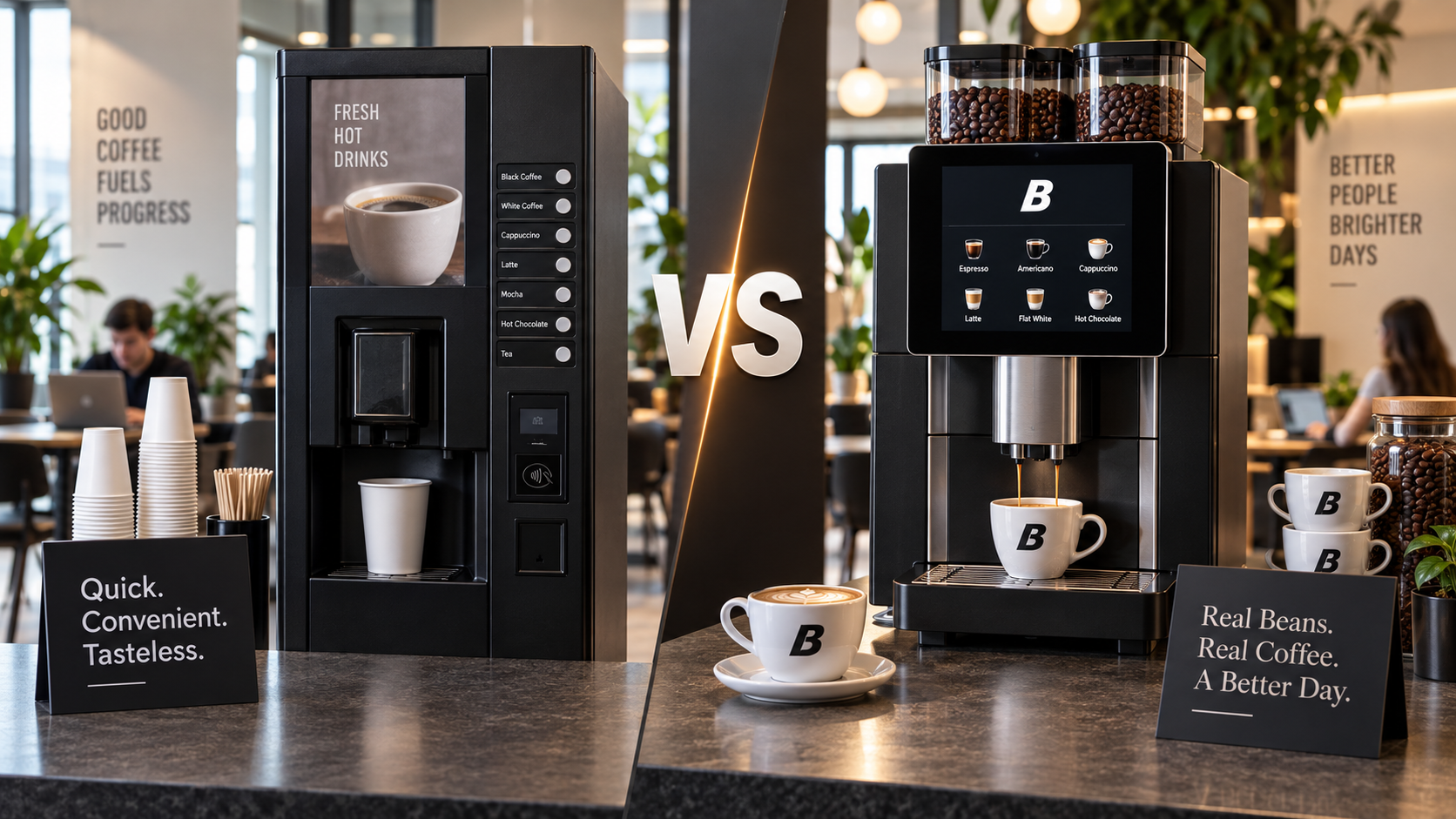
If you're weighing up a coffee vending machine vs bean-to-cup machine for your office, the short answer is: bean-to-cup wins on quality and cost per cup for most offices, but a vending machine can still be the more practical choice at very high, minimal-touch volume. Blend 2 Vend supplies bean-to-cup machines, so here's the comparison as straight as we can put it, including where we'd honestly point you elsewhere.
Drink Quality: Instant Granules or Powdered Mixes vs Fresh Beans
This is the biggest practical difference between the two technologies:
- Coffee vending machines typically use instant granules or pre-mixed powders for milk drinks, dispensed into a cup — quick and consistent, but the drink quality is closer to instant coffee than a proper espresso-based drink
- Bean-to-cup machines grind whole beans and steam fresh milk per cup, producing a genuine espresso-based drink much closer to what most people would order at a coffee shop
- The gap has narrowed a bit as vending technology has improved, but a bean-to-cup drink is still the clear winner on taste for anyone used to café-standard coffee
For an office positioning coffee as a genuine perk rather than just a caffeine dispenser, this difference is usually the deciding factor on its own.
Cost Per Cup and Total Running Cost
Vending machines are often assumed to be cheaper, but the comparison depends on what's being counted:
- Per-cup ingredient cost can be lower for vending, since instant granules and powdered mixes cost less than fresh beans and milk
- Total running cost also includes the machine itself (purchase, rental or lease), servicing, and restocking labour — where the difference between the two technologies narrows considerably once a managed service is handling both
- A fully managed bean-to-cup service bundles machine, servicing and restocking into one predictable monthly cost, which is a fairer comparison to a vending contract than comparing raw ingredient cost alone
See our guide to commercial coffee machine running costs for a fuller breakdown of what actually makes up the monthly cost of an office coffee machine.
Volume and Footfall: Where Vending Still Wins
This is the honest part of the comparison. There's a genuine volume threshold where vending's simplicity becomes an advantage:
- Very high-footfall, minimal-touch environments — think a large factory floor, a busy transport hub, or an unsupervised 24-hour break room — can suit vending better, since there's no milk to run out mid-shift and less that can go wrong unattended
- A typical office, even a large one with several hundred staff, rarely hits the volume where this trade-off actually favours vending over a well-sized bean-to-cup setup, since bean-to-cup machines scale by adding units or choosing a higher-throughput model rather than switching technology
- If your actual use case is closer to industrial or transport-hub volume than office headcount, a vending specialist may genuinely be the better call — that's a fair thing for us to say even though it's not what we sell
Footprint, Maintenance and Staff Admin
Beyond the drink itself, the two technologies differ in what they ask of your team:
- Vending machines are generally simple to keep running, with less that needs regular attention beyond restocking cups and ingredients
- Bean-to-cup machines need bean hoppers and milk topped up more frequently (fresh milk in particular), which is exactly why a managed restocking service — rather than leaving it to reception or office staff — matters more for bean-to-cup
- Footprint is broadly similar for most models of either type, though this varies machine to machine and is worth checking against your actual space during a consultation rather than assumed from the category alone
How Blend 2 Vend Approaches This
Whichever way you'd rather acquire the machine, the service is the same:
- Free consultation to size the machine to your actual headcount and usage pattern, not just assumed from office size
- Free demo, so your team can try the coffee before committing
- Professional installation
- On-site training for whoever tops up the machine day to day
- Ongoing servicing, maintenance and a support line
- Regular restocking of beans, milk and consumables, so fresh milk running out isn't left to chance
Rental, lease to own and outright purchase are all available — see our rental vs lease to own comparison if you're deciding between those, or get in touch about outright purchase.
Frequently Asked Questions
Is a vending machine really cheaper than bean-to-cup?
Per-cup ingredient cost can be lower for vending, but once machine cost, servicing and restocking are included in a fully managed service, the total cost gap narrows considerably — and bean-to-cup wins clearly on drink quality for the same comparison.
We have several hundred staff — do we need vending to handle the volume?
Usually not. A typical office, even a large one, is rarely at the volume where vending's simplicity outweighs bean-to-cup's quality advantage — bean-to-cup setups scale by adding units or choosing a higher-throughput model. Vending tends to make more sense at industrial or transport-hub volumes, well above typical office headcount.
Does bean-to-cup need more day-to-day attention than vending?
Slightly, mainly around topping up fresh milk more often — which is why a managed restocking service matters more for bean-to-cup than it does for vending.
Can we start with a smaller bean-to-cup setup and add capacity later?
Yes, get in touch about upgrading to a higher-throughput machine or adding units as headcount grows — this is part of an ongoing rental or lease to own relationship rather than a one-off decision.
Ready to Get Started?
Blend 2 Vend provides fully managed bean-to-cup coffee solutions for offices across the UK, sized to your actual headcount and usage pattern.
Book a free demo → and we'll bring a machine to you, or speak to a specialist about whether bean-to-cup or vending is the right fit for your office.