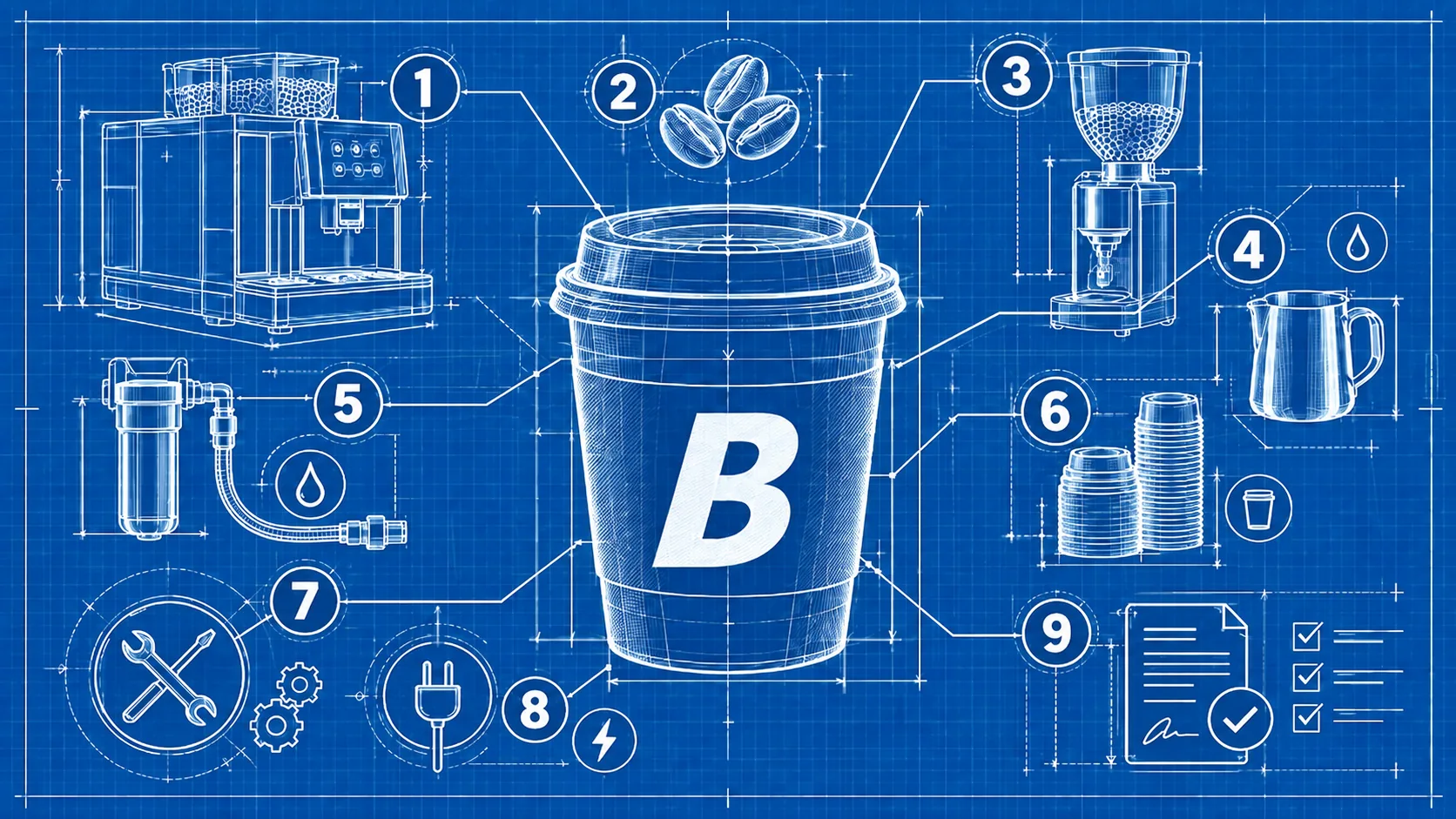
If you are buying a commercial coffee machine outright, the price tag is the least useful number you'll see. What decides whether it was a good purchase is whether the machine is sized for your busiest ten minutes, holds its temperature, fits your site's power and water supply, and has someone reliable to service it for the next several years.
Buying is a perfectly sound route. You own the asset from day one and carry no monthly finance commitment. The nine checks below are the ones we'd make before handing over the money. If you get to the end and buying no longer looks right, our lease vs buy guide compares buying with lease to own.
Check 1: Size It on Peak Demand, Not Headcount
Headcount tells you very little. What matters is how many drinks the machine has to make in its busiest window: first thing in the morning, just after lunch, or the rush after a class, a meeting or a check-in wave.
A rough sequence that works:
- Estimate cups per day, then estimate how many of those fall in the busiest half-hour
- Check the machine's rated daily output and how quickly it makes consecutive drinks
- Leave headroom for growth. A machine running at its limit every day wears faster and builds queues.
For reference, even our entry-level machines handle up to around 100 cups a day, and our high-output machines are built for 300 or more. For most sites the real question is speed at peak time, not whether the machine can cope over the whole day. Our guide to choosing an office coffee machine goes into sizing in more detail.
Check 2: Test the Temperature Before You Test the Menu
This is the check most people skip, and in our view it is the one that matters most. A lot of bean-to-cup machines can't hold temperature properly and serve coffee that is lukewarm by the time it reaches a desk or a customer's table. No menu or touchscreen fixes that.
At a demo, taste a drink the way it will actually be drunk, which is usually a milk-based coffee a minute or two after it's poured. Then ask the supplier directly whether brew temperature is adjustable. If they can't answer clearly, treat that as your answer.
Check 3: Confirm the Site Is Ready
Buyers tend to focus on the machine and forget the space it has to go into. Before you order, check:
- Power: is there a suitable socket or supply where the machine will sit? Get the electrical requirement from the spec sheet, not the brochure.
- Water: will the machine be plumbed in or run from a tank? A plumbed machine needs a water supply nearby. A tank needs someone to refill it.
- Drainage: does the model need a waste connection?
- Water quality: limescale is a common cause of faults in hard-water areas, so ask what filtration is included
- Space and access: counter depth, clearance above for loading beans, and a clear route in on installation day
Finding a problem in any of these after the machine has arrived costs more than finding it in a site survey.
Check 4: Match the Drinks Menu to Who Is Actually Drinking
Work out who will use it before you choose features. An office that drinks mostly americanos and flat whites needs something different from a gym café where people want iced coffee after a session, or a co-working space where some members want hot chocolate or chai.
Our entry-level machines make coffee and iced coffee. The mid-range adds drinks like matcha, hot chocolate and chai. If you plan to sell coffee rather than give it to staff, the menu is also a revenue decision. Our profit calculator shows what a better cup can earn at your volume.
Check 5: Find Out Who Services It After You've Paid
This is where outright purchases most often go wrong. A machine bought cheaply online, or from a seller who only sells machines, can leave you with nobody to call when it throws an error code on a Monday morning.
Before you buy, get clear answers to:
- Who carries out routine servicing and deep cleans, and how often?
- How do you report a fault, and how quickly does someone respond?
- Is there phone support that can talk your team through a problem?
- Is staff training included at installation?
We'd also read the service agreement with the same care as a lease. Our guide to coffee machine contract terms covers the clauses worth questioning.
Check 6: Understand the Real Cost Beyond the Price Tag
The purchase price is only one part of what you'll spend. Over the life of the machine you'll also pay for:
- Servicing and repairs
- Beans, milk and cups
- Cleaning products and water filters
- Staff time spent restocking and cleaning, if the supplier doesn't handle it
- Downtime, which costs you twice on a site that sells coffee
Add these up over the years you expect to keep the machine and set the total against the alternatives. We break down the running costs in our guide to commercial coffee machine running costs.
Check 7: Ask About Beans and Consumables
Some suppliers tie you to their own beans, and some machines are set up for a particular grind and roast. Neither is necessarily a problem, but you should know before you buy:
- Can you choose your own beans, or are you tied to the supplier's?
- Who orders and delivers consumables, and on what schedule?
- What does it cost per kilo, and is that price fixed or subject to review?
Good beans matter as much as a good machine. We supply ours through a small-batch roaster in Brighton, because a premium machine running supermarket beans is a waste of the machine.
Check 8: Get Warranty and Parts Terms in Writing
Ask what the warranty covers, for how long, and what voids it. Using unapproved cleaning products or skipping scheduled servicing are common exclusions. Ask as well how quickly parts can be sourced for that model. An imported machine with slow-moving parts can sit out of action for a long time over one small fault.
Check 9: Decide How to Pay
Once you know the machine is right, there are three ways to pay for owning it:
- Outright: one payment, and the machine is yours immediately. Our outright purchase prices are quoted on request, because they depend on the machine and the site.
- Buy now pay later: you still own the machine from day one, but the cost is spread out.
- Lease to own: no upfront cost and fixed monthly payments, with the machine yours at the end of the term. Ours starts from £89 per month through Shire Leasing, subject to eligibility. See lease to own.
All three routes end with the machine belonging to you, which is why we don't offer rental. Our lease vs buy guide compares the routes in more depth.
On tax, plant and machinery a business buys may qualify for capital allowances. HMRC's guidance on the Annual Investment Allowance is the place to start, and your accountant is the right person to confirm how it applies to you.
How Blend 2 Vend Approaches This
We sell machines outright, with buy now pay later, or on lease to own. The service is identical on all three: installation, on-site staff training, scheduled servicing and deep cleans, bean and consumable restocking, a 24-hour support line and a next-day callout if an engineer is needed.
If you buy outright, you still get all of that. We quote the machine and the ongoing service and supplies separately, so you can see exactly what you are paying for.
Before we recommend anything, we visit for a free demo and taste test. You taste the coffee at the temperature it will actually be served, and we check the site at the same visit. As one customer put it in a Google review: "The machine has been reliable from day one, easy to use, and produces excellent coffee every time."
Frequently Asked Questions
Is it cheaper to buy a commercial coffee machine or lease one? Over a long enough period, buying outright usually costs less in total because there is no finance cost. Leasing protects your cash flow, with no upfront cost and ownership at the end of the term. The right answer depends on whether you have the capital and would rather use it elsewhere.
Do I still get servicing if I buy the machine outright? With us, yes. Installation, training, servicing and restocking are available whichever route you choose. For outright purchases, the service and supplies are quoted separately from the machine. Check this with any supplier before you buy, because not every seller services what they sell.
Can I buy a coffee machine with buy now pay later? Yes. Buy now pay later lets you own the machine from day one while spreading the cost. Ask us for a price and we'll set out both the outright figure and the spread option.
How long does a commercial bean-to-cup machine last? It depends heavily on how hard it's worked and how well it's maintained. Regular servicing, correct water filtration and daily cleaning make a bigger difference than the badge on the front. Ask any supplier what they expect for the specific model at your volume.
What should I check at a coffee machine demo? Taste a milk-based drink a minute or two after pouring to check temperature. Time how long consecutive drinks take. Ask who services the machine and how fast they respond, and confirm what your site needs for power, water and drainage.
Thinking About Buying a Machine?
Book a free demo and taste test, and we'll check your site, recommend the right machine and give you an outright price, with buy now pay later and lease options shown alongside so you can compare them properly.
Book a free demo → or speak to a specialist.